

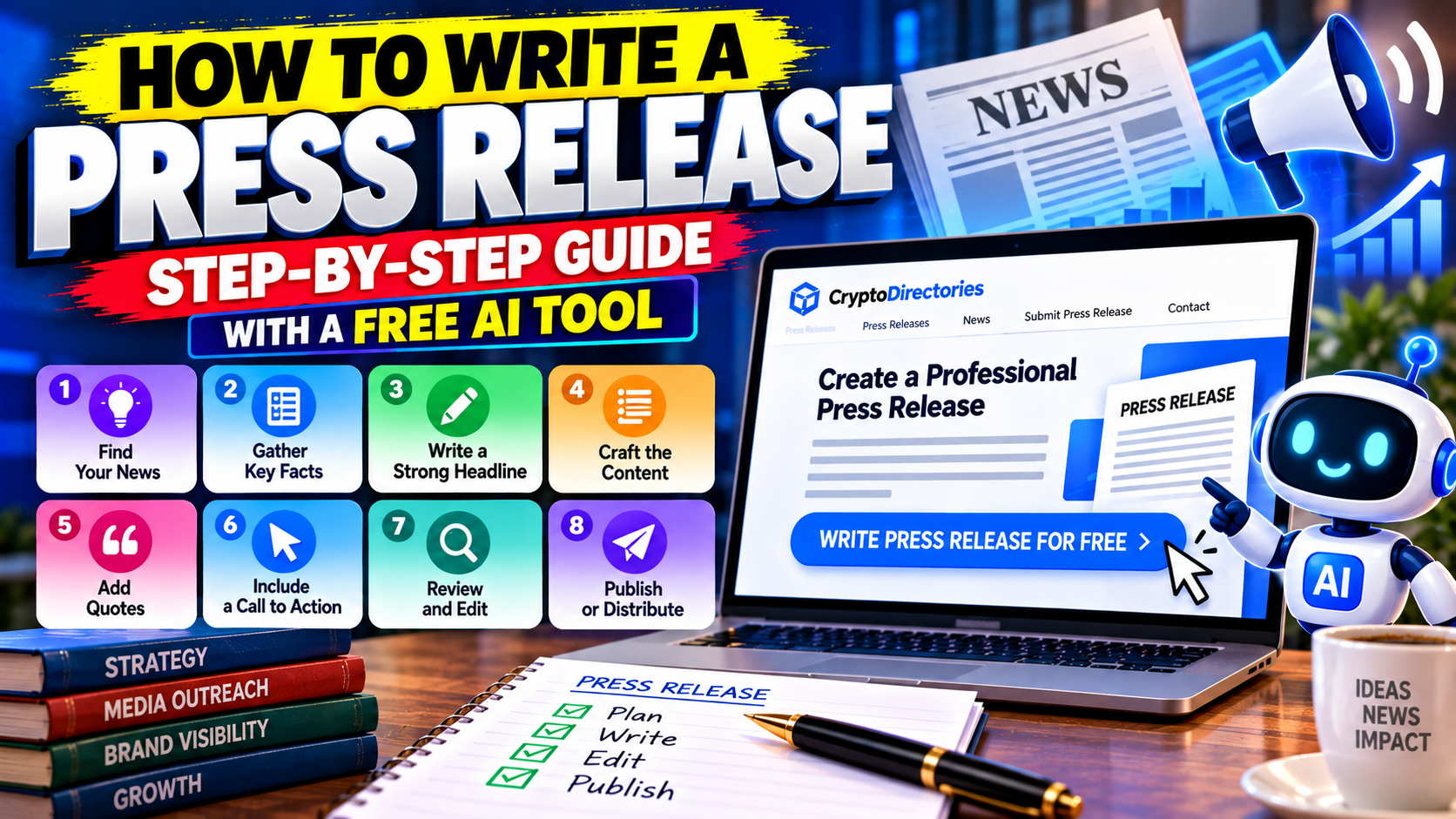
Learning how to write a press release is easier when you understand the structure behind a good announcement.
A press release is not simply a blog post with a company name at the top. It is a structured announcement designed to communicate important news clearly and efficiently.
Companies use press releases to announce product launches, partnerships, funding, events, expansions, executive appointments, acquisitions, milestones, technology releases, research, and other developments that are worth communicating publicly.
The writing process can be handled by an internal team, a professional writer, a PR agency, or an AI-assisted writing tool.
For businesses that want to create a press release without paying a writer just to produce the first draft, CryptoDirectories offers a free AI press release writing tool that can help turn your announcement details into a structured release.
Create your press release for free: https://cryptodirectories.com/press/
What Is a Press Release?
A press release is a formal written announcement about a company, organization, project, product, service, event, partnership, milestone, or other newsworthy development.
Its purpose is to communicate information in a format that can be understood and evaluated quickly.
A typical press release includes:
- A headline
- An optional subheadline
- A dateline
- A lead paragraph
- Supporting information
- One or more quotes
- A call to action
- Company or organization information
- Media contact information where appropriate
The exact formatting can vary depending on the publication or distribution service, but the underlying writing principles are broadly similar.
How to Write a Press Release
The easiest way to learn how to write a press release is to break the process into individual steps.
You do not need to write the entire document in one sitting.
Instead:
Identify the news → collect the facts → write the headline → write the lead → develop the body → add quotes → add the call to action → review → publish or distribute.
Each step has a specific purpose.
Step 1: Decide What You Are Actually Announcing
Before writing anything, identify the news.
Ask yourself:
What happened?
This sounds obvious, but it is one of the most important questions in press release writing.
For example:
“Our company is changing the future of the industry.”
That is a marketing statement.
Compare it with:
“ABC Technologies launched a new payment platform for online merchants.”
That is an announcement.
A strong press release starts with something concrete.
Your announcement might be:
- A product launch
- A new service
- A strategic partnership
- A funding announcement
- A company expansion
- A new office
- A major milestone
- An acquisition
- A leadership appointment
- A technology update
- A research announcement
- An event
- A new market entry
If you cannot describe the announcement in one or two clear sentences, spend more time clarifying the story before you begin writing.
Step 2: Identify Who, What, When, Where, and Why
A practical approach to writing a press release is to begin with the basic questions journalists and readers naturally ask.
Who?
Who is making the announcement?
What?
What exactly happened?
When?
When did the announcement happen or when will it happen?
Where?
Where is the event, launch, expansion, or development taking place?
Why?
Why does the announcement matter?
These five questions help you identify the information that belongs near the beginning of the release.
Step 3: Gather Your Facts Before Writing
Do not start by trying to sound professional.
Start by gathering information.
Create a simple fact sheet containing:
- Company name
- Project name
- Product name
- Announcement date
- Location
- Product description
- Important features
- Statistics
- Partnership details
- Executive names
- Quotes
- Official URLs
- Company description
- Call to action
This step becomes even more important when using AI.
An AI tool should organize and improve the information you provide. It should not be treated as the source of facts about your company.
Step 4: Identify Your Target Reader
Ask who should care about this announcement.
Your audience might include:
- Customers
- Investors
- Developers
- Business owners
- Industry professionals
- Journalists
- Publishers
- Partners
- Local communities
- General consumers
Your audience affects the amount of technical information you should include.
For example, a developer audience may need detailed technical information.
A general business audience may need a simple explanation of the product and its practical value.
Step 5: Write the Press Release Headline
The headline should communicate the announcement clearly.
A useful headline formula is:
[Company] + [Action] + [Announcement] + [Relevant Context]
Examples:
NovaTech Launches New AI Platform for Small Businesses
ABC FinTech Partners With Global Payment Provider to Expand Digital Asset Services
XYZ Opens New Research Center to Advance Blockchain Infrastructure
Notice that each headline tells the reader what happened.
Weak Headline
A New Era of Innovation Begins Today
Better Headline
ABC Technologies Launches New Automation Platform for Online Retailers
The second version gives the reader useful information immediately.
Step 6: Write the Subheadline
A subheadline is optional.
When used, it can provide additional context that does not fit naturally into the main headline.
For example:
Headline
NovaPay Launches New Digital Payment Platform
Subheadline
The new platform is designed to help online merchants accept supported digital assets through a simplified checkout experience.
The headline communicates the event.
The subheadline provides context.
Step 7: Write the Dateline
A dateline usually identifies the location and date associated with the announcement.
A basic structure is:
NEW YORK, NY – June 15, 2026 –
The exact format can vary depending on the distribution service or publisher.
Do not invent a location simply because the format normally contains one. Use the correct information associated with the announcement.
Step 8: Write the Lead Paragraph
The lead is one of the most important parts of the entire release.
It should explain the main announcement quickly.
A practical formula is:
Who + what happened + important context + why it matters.
Example:
“ABC Technologies today announced the launch of its new automation platform, giving small businesses tools for managing repetitive customer-service tasks through a centralized workflow.”
The reader immediately understands what happened.
What the Lead Should Avoid
Avoid opening with several sentences of company history.
Avoid generic statements such as:
“ABC Technologies is proud to announce an exciting and revolutionary new chapter.”
The sentence tells the reader how the company feels but does not tell them what happened.
Step 9: Explain the Announcement
After the lead, explain the development in more detail.
You might discuss:
- What the product does
- Who can use it
- What problem it solves
- How the partnership works
- Important features
- Relevant data
- What happens next
Think of the body as answering the follow-up questions created by the lead.
Step 10: Add Useful Supporting Facts
Numbers and specific information can make an announcement more concrete.
For example:
Instead of:
“The company has experienced tremendous growth.”
Use:
“The company said its platform now supports more than 100,000 registered users.”
Only use figures that are accurate and can be supported by your source information.
Specific facts are generally stronger than unsupported adjectives.
Step 11: Add a Quote
A good quote adds perspective.
It should sound like something a real person would say and should contribute something beyond the information already stated.
A useful executive quote can explain:
- Why the product was created
- What problem the company is addressing
- Why the partnership matters
- What customers can expect
- What the company plans to do next
Weak Quote
“We are very excited about this exciting new product.”
Better Quote
“Small businesses often spend too much time managing repetitive operational tasks, so we built this platform to simplify those workflows without requiring a large technical team,” said Alex Morgan, CEO of ABC Technologies.
The second quote communicates an actual idea.
Step 12: Add a Second Quote When Appropriate
A second quote can come from:
- A partner
- A customer
- A technical leader
- An industry expert
- Another executive
Do not add a second quote simply to make the release longer.
Use it when the second person provides a genuinely different perspective.
Step 13: Explain Why the Announcement Matters
One of the easiest ways to improve a release is to explain significance.
Ask:
Why should anyone care?
Possible answers include:
- The product solves an existing problem
- The partnership creates a new capability
- The company is entering a new market
- The announcement affects customers
- The technology enables a new use case
- The business reached a meaningful milestone
Be specific.
Do not rely on statements such as “this will change everything” unless there is evidence that supports such a claim.
Step 14: Add the Call to Action
Tell the reader what to do next.
A call to action could invite readers to:
- Visit the website
- Try the product
- Register for an event
- Join a waitlist
- Read documentation
- Contact the company
- Learn more about the announcement
Keep the call to action relevant to the announcement.
Step 15: Write the Company Boilerplate
The boilerplate is the short “About the Company” section at the end of the release.
It should explain what the company does.
Example:
“About ABC Technologies: ABC Technologies develops software tools that help small and mid-sized businesses automate repetitive workflows and improve operational efficiency.”
Keep it factual and concise.
Step 16: Add Media Contact Information
A traditional release may include a media contact section containing information such as:
- Contact name
- Company
- Website
Use current and accurate contact information.
Step 17: Review the Entire Press Release
This is where many otherwise good releases fail.
Do not assume your first draft is finished.
Read the entire document again.
Check:
- Names
- Dates
- Locations
- Statistics
- Product names
- Company names
- Quotes
- Links
- Technical claims
- Spelling
- Grammar
Then ask whether the announcement is understandable to someone who has never heard of your company.
Complete Press Release Structure
A basic press release can follow this sequence:
FOR IMMEDIATE RELEASE
[Headline]
[Optional Subheadline]
[CITY, COUNTRY – DATE] – [Company] today announced [main news].
[Supporting paragraph explaining the announcement.]
[Additional facts, features, context, or statistics.]
“[Relevant quote],” said [Name], [Title] at [Company].
[Additional supporting information.]
[Optional second quote.]
[Call to action and official website.]
About [Company]
[Company description.]
Media Contact
[Name]
[Company]
[Email]
[Website]
Press Release Example
Here is a simple fictional example.
NovaTech Launches AI Automation Platform for Small Businesses
AUSTIN, TX – June 15, 2026 – NovaTech today announced the launch of a new AI automation platform designed to help small businesses manage repetitive customer-service and administrative workflows.
The platform combines automated workflow tools with AI-assisted task management, allowing businesses to organize frequently repeated processes through a centralized system.
“Small businesses often lose valuable time performing repetitive tasks manually,” said Jamie Morgan, CEO of NovaTech. “We built the platform to help teams automate those workflows without requiring a large technical staff.”
The platform is now available through the company’s website, where businesses can learn more about available features and access options.
About NovaTech
NovaTech develops software tools that help small and mid-sized businesses automate repetitive operational processes.
Media Contact
Jamie Morgan
NovaTech
media@example.com
NovaTech.com
The example is intentionally straightforward.
It does not rely on excessive marketing language.
The reader can understand what happened and what the product does.
How to Write a Press Release for a Product Launch
Product launches are one of the most common reasons companies create press releases.
For a product launch, answer:
- What is the product?
- Who launched it?
- When is it available?
- Who is it for?
- What problem does it solve?
- What are the most important features?
- Where can people learn more?
Avoid turning the announcement into a product page.
The press release should explain the launch as news.
How to Write a Press Release for a Partnership
Partnership announcements should explain more than the fact that two companies signed an agreement.
Explain:
- Who the partners are
- Why they are working together
- What they will build or provide
- Who benefits
- What happens next
Weak:
“ABC and XYZ are thrilled to announce a groundbreaking strategic partnership.”
Better:
“ABC and XYZ today announced a partnership to integrate XYZ’s payment infrastructure into ABC’s online merchant platform.”
The second version tells the reader what the partnership actually involves.
How to Write a Press Release for Funding
A funding announcement should clearly explain the funding event and provide relevant information about the company and intended use of the capital where appropriate.
A basic structure might include:
- Funding amount
- Funding round
- Participating investors where publicly disclosed
- Company background
- How the company plans to use the capital
- Quote from the founder or executive
Make sure all financial figures are accurate and approved before publication.
How to Write a Press Release for a New Service
Focus on the service itself and the problem it is designed to solve.
Explain:
What is the service?
Who can use it?
What problem does it address?
When is it available?
How can readers learn more?
Do not assume the reader already understands what makes your service different.
How to Write a Press Release for an Event
For an event announcement, the practical details matter.
Include:
- Event name
- Date
- Location
- Purpose
- Speakers or participants where confirmed
- Who should attend
- Registration information
The reader should be able to determine quickly whether the event is relevant to them.
How to Write a Press Release for a Company Milestone
Milestones can include:
- Customer growth
- New market entry
- Major product adoption
- Anniversary
- Revenue milestones
- Production milestones
- New locations
Use exact numbers and dates when appropriate.
Specific evidence makes a milestone announcement more credible than vague statements about success.
How to Write a Crypto Press Release
Crypto and blockchain announcements require additional care because the underlying technology can be difficult for general readers to understand.
A crypto release should clearly explain:
- What the project or company does
- What is being announced
- What technology is involved
- Who benefits
- Why the development matters
- Where readers can learn more
For a dedicated crypto tutorial, read our guide on how to write a crypto press release with AI.
You can also create your crypto press release using the free CryptoDirectories AI press release tool.
How to Write a Blockchain Press Release
Blockchain terminology can quickly make a release difficult to understand.
Use a layered explanation.
First explain what the product does in simple language.
Then explain the practical benefit.
Then provide the technical context for readers who want more detail.
For example:
Simple explanation: The platform allows developers to build applications across multiple blockchain networks.
Practical benefit: Developers can manage supported networks through a centralized infrastructure layer.
Technical context: The platform provides APIs and infrastructure for interacting with supported blockchain environments.
This structure keeps the announcement accessible without removing useful technical information.
How to Write a Web3 Press Release
Web3 announcements often involve unfamiliar terminology.
Do not assume every reader knows what a protocol, layer, wallet, bridge, smart contract, or decentralized application does.
Explain the role of the technology in plain language first.
Then provide the technical details that matter.
How to Write a Press Release With AI
AI can make press release writing faster.
Instead of beginning with a blank page, give the AI system the information it needs.
Provide:
- Company name
- Announcement
- Product details
- Important dates
- Location
- Audience
- Key statistics
- Quotes
- Partner information
- Official links
- Company boilerplate
Then use the AI to help organize that information into a professional press release structure.
After the draft is created, review it carefully.
AI draft does not equal final copy.
Free AI Press Release Writing
You do not necessarily need to pay for a professional writer simply to transform your notes into a first draft.
CryptoDirectories provides a free AI press release writing tool that can help organize your announcement into a structured release.
You can use the tool to:
- Generate a starting draft
- Develop a headline
- Structure the opening paragraph
- Organize supporting information
- Prepare a company description
- Draft a call to action
You then remain in control of the final content.
Start writing your press release for free: https://cryptodirectories.com/press/
How to Write a Press Release With AI Without Making It Generic
The quality of the input matters.
Compare these two prompts.
Generic:
“Write an exciting press release about our new product.”
Specific:
“Our company launched a payment platform on June 15 for online merchants. The platform supports three payment networks, integrates through an API, and is initially available in the United States and United Kingdom. The CEO’s approved quote is…”
The second prompt gives the AI actual information to work with.
Specific source material helps reduce generic writing.
Should AI Write the Entire Press Release?
AI can generate a complete draft.
That does not mean the draft should be published without review.
A practical workflow is:
Real information → AI draft → Human review → Fact verification → Final copy.
The AI handles much of the repetitive drafting work.
The human remains responsible for accuracy, judgment, and approval.
How to Make a Press Release Sound Human
AI-generated releases can sometimes sound overly polished or repetitive.
To make the final copy more natural:
- Use specific company information
- Include real quotes
- Remove repetitive phrases
- Delete unnecessary adjectives
- Shorten complicated sentences
- Use terminology your customers actually use
- Add information that only your organization knows
Do not be afraid to edit an AI draft heavily.
The objective is not to preserve the AI’s wording.
The objective is to produce the strongest final announcement.
How to Write a Press Release Headline That Gets Attention
Attention does not require sensationalism.
A specific headline can be more useful than a dramatic one.
Compare:
“The Future of Blockchain Has Finally Arrived”
with:
“NovaChain Launches New Blockchain Infrastructure Platform for Developers”
The second headline gives the reader a reason to continue because the reader knows what happened.
How to Write a Strong Press Release Introduction
The introduction should answer the most important questions quickly.
Try to communicate:
- The organization
- The announcement
- The product or development
- The audience
- The significance
You do not need to force all five into one sentence.
The goal is clarity rather than a complicated formula.
How Many Words Should a Press Release Have?
There is no universal word count that guarantees success.
A straightforward announcement may need only a modest amount of copy.
A complex product launch or technical announcement may require additional explanation.
The correct length is the shortest length that fully communicates the news.
Do not add paragraphs simply to make the release appear more substantial.
How Many Quotes Should a Press Release Have?
Many releases use one or two meaningful quotes.
The exact number depends on the announcement.
A release does not become more professional simply because it contains more quotes.
Use quotes when they provide perspective that the factual sections cannot provide.
How to Write a Press Release Without Hype
One of the most important writing skills is replacing vague praise with specific facts.
Instead of:
“Our revolutionary platform is the most advanced solution on the market.”
Explain what the platform actually does.
For example:
“The platform allows merchants to manage supported payment methods through a single dashboard.”
Facts give the reader something concrete.
Common Press Release Writing Mistakes
Starting With Company History
The announcement should come first.
Using Too Much Promotional Language
Do not make every sentence sound like an advertisement.
Writing a Vague Headline
Tell readers what happened.
Using Generic Quotes
Make quotes meaningful.
Adding Unsupported Claims
Verify major statements and statistics.
Using Too Much Jargon
Explain technical concepts in understandable language.
Burying the Main Story
The most important information should appear near the beginning.
Publishing AI Copy Without Review
Always verify the final document.
Keyword Stuffing
Use search terms naturally rather than repeating exact phrases in every paragraph.
How to Improve an Existing Press Release
You do not always need to start from scratch.
If you already have a draft, edit it systematically.
Improve the Headline
Does it explain the news?
Improve the Opening
Does the first paragraph explain what happened?
Remove Filler
Delete sentences that add no useful information.
Replace Hype With Facts
Whenever possible, use specific evidence.
Improve the Quote
Does the quote add perspective?
Check the Call to Action
Does the reader know where to go next?
Press Release Writing for SEO
Press releases should primarily be written for people who need to understand the announcement.
However, natural search optimization can be incorporated into the writing process.
Use:
- Descriptive headlines
- Clear headings
- Natural industry terminology
- Relevant company and product names
- Useful links
- Specific information
- Readable formatting
Do not repeat the same keyword simply because it is your target phrase.
For a broader explanation of these principles, visit our complete press release writing guide.
Press Release Writing for AIEO
If you want content to be easier for AI-powered answer systems to understand, clarity becomes especially important.
State the important facts explicitly.
For example:
Who: ABC Technologies
What: Launched a blockchain analytics platform
When: June 15, 2026
Who is it for: Web3 developers and crypto businesses
What does it do: Provides tools for monitoring and analyzing supported blockchain activity
This kind of clear structure helps human readers and systems understand the subject quickly.
How to Write a Press Release for Crypto
Crypto companies can use the same basic press release structure as other businesses, but the explanation needs to be precise.
For example, if you are announcing a new blockchain platform, do not simply say that it is “revolutionary.”
Explain:
- What the platform does
- Which users it targets
- What infrastructure it provides
- What problem it addresses
- What stage the product is in
- Where readers can learn more
Our dedicated crypto press release writing guide provides a more specialized framework.
Can a Small Business Write a Press Release?
Yes.
Small businesses do not need to be large corporations to create a legitimate announcement.
A small business might announce:
- A new location
- A new service
- A major partnership
- A product launch
- An expansion
- An event
- A milestone
The same basic writing principles apply.
Can a Startup Write a Press Release?
Yes.
Startups can create releases for significant launches, funding announcements, partnerships, expansion, milestones, technology releases, and other legitimate news.
A startup does not need to sound like a multinational corporation.
It needs to explain what happened.
Can a Founder Write Their Own Press Release?
Absolutely.
A founder often knows the product, customers, problem, and announcement better than anyone else.
The challenge is turning that knowledge into a document that an outside reader can understand.
A structured template and AI-assisted writing tool can reduce that difficulty.
When Should You Hire a Press Release Writing Service?
There are situations where professional writing can provide meaningful value.
Consider a professional writer when:
- The announcement is strategically important
- The subject is highly technical
- You need research or interviews
- Your team lacks PR writing experience
- You need several revision rounds
- The release is part of a larger PR campaign
For a deeper comparison, see our article about professional press release writing services.
You can also compare the broader options in our guide to press release writing services, pricing, benefits, and free AI alternatives.
When You Can Use a Free AI Press Release Tool Instead
A free AI-assisted workflow can make sense when your main problem is creating the first draft.
For example, you already know:
- What happened
- When it happened
- Who is involved
- What the product does
- Who it is for
- What the next step is
You may not need to pay a professional writer to discover or organize that information.
You can provide the information to an AI tool, generate the draft, review it, and make final edits internally.
Try the free CryptoDirectories AI press release writing tool here.
How to Write a Press Release Faster
The fastest writers are not necessarily those who type the fastest.
They usually have a repeatable process.
Use a standard briefing form.
Keep your company boilerplate ready.
Maintain approved company information.
Keep executive information current.
Use an AI tool for the first draft.
Review the final release before publication.
This process reduces the amount of time spent starting from zero.
A Simple Press Release Writing Workflow
Here is a practical workflow for businesses.
1. Collect information.
Gather the facts about the announcement.
2. Identify the story.
Reduce the announcement to one clear central idea.
3. Generate the draft.
Use a template, writer, or AI-assisted tool.
4. Review the headline.
Make sure the news is obvious.
5. Review the lead.
Make sure the reader understands what happened.
6. Verify the body.
Check all facts and numbers.
7. Approve the quote.
Make sure the quoted person approves the wording.
8. Add the call to action.
Point readers to the official next step.
9. Final edit.
Remove unnecessary words and unsupported claims.
10. Publish or distribute.
Choose the appropriate publication or distribution method.
How to Create a Press Release for Free
If budget is your main concern, you do not have to hire a professional writer just to create the first version.
You can create a draft yourself using a template.
Or you can use AI assistance.
CryptoDirectories lets you create a press release for free using its AI-assisted writing workflow.
The process starts with your announcement rather than a blank page.
That means you can focus on supplying accurate information and reviewing the result.
Create your free release: https://cryptodirectories.com/press/
How to Review an AI-Generated Press Release
Use a factual review checklist.
Names
Check company, product, executive, partner, and organization names.
Dates
Check announcement dates, launch dates, event dates, and other time-sensitive information.
Numbers
Verify funding figures, user counts, percentages, measurements, and statistics.
Technical Information
Make sure the product is described accurately.
Quotes
Confirm the quoted person approves the final wording.
URLs
Test all important links.
Claims
Remove or revise unsupported claims.
How to Write a Press Release That Journalists Can Understand
Even if you are not directly pitching journalists, write for a reader who is unfamiliar with your company.
That means avoiding:
- Long company histories at the beginning
- Excessive jargon
- Unexplained acronyms
- Vague claims
- Marketing filler
- Huge blocks of text
Instead, give readers the information they need in a logical order.
Should a Press Release Be Written in Third Person?
Traditional press releases are generally written from an external perspective rather than as a first-person company announcement.
For example:
Third person: ABC Technologies today announced the launch of its platform.
Rather than:
First person: We are excited to announce our new platform.
The first approach generally fits a conventional press release format better.
Quotes are the natural place for first-person language.
Should You Include Links in a Press Release?
Relevant links can make the announcement more useful.
Examples include:
- Official company website
- Product page
- Documentation
- Event registration
- Application page
- Contact page
Use links because they help the reader, not simply because you want to add as many links as possible.
How to Write a Press Release That Is Easy to Scan
Readers are busy.
Make the release visually and structurally easy to understand.
Use:
- Short paragraphs
- Clear headings where appropriate
- Specific sentences
- Relevant quotes
- Simple explanations
- Useful links
A press release should be easy to understand at a glance.
Press Release Writing vs. Press Release Distribution
Writing and distribution are two separate activities.
Press release writing creates the announcement.
Press release distribution determines where and how that announcement is published or delivered.
A strong distribution service cannot fix a badly written release.
Likewise, excellent writing does not guarantee that an announcement will receive coverage simply because it was published.
That is why it makes sense to treat writing and distribution as separate parts of the communication process.
How a Press Release Writing Service Differs From an AI Tool
A professional writing service may provide:
- Research
- Interviews
- Editorial judgment
- Revisions
- Industry expertise
- Strategic messaging
An AI tool is typically strongest at:
- Fast drafting
- Structure
- Rewriting
- Headline ideas
- Formatting assistance
- First-draft generation
For more information about comparing these options, read our professional press release writing service guide.
How to Decide Between AI and Professional Writing
Ask what you actually need.
Need a first draft?
AI may be enough.
Need strategic messaging?
A professional may be more appropriate.
Need research and interviews?
A human writer may be the better choice.
Need media outreach?
Writing alone is not enough.
Need a simple routine announcement?
A free AI-assisted workflow may solve most of the problem.
How to Build a Repeatable Press Release Process
Businesses that publish announcements frequently should create a system.
Maintain a central document with:
- Company description
- Executive bios
- Approved terminology
- Brand information
- Official URLs
- Media contact information
- Common product descriptions
Then each new announcement only requires the specific facts related to that story.
This makes it much easier to publish consistently.
Press Release Writing Checklist
Before publishing your release, ask:
- Is the main announcement obvious?
- Does the headline clearly describe what happened?
- Does the opening paragraph explain the news?
- Are who, what, when, where, and why covered?
- Are all dates accurate?
- Are all statistics accurate?
- Are company and product names correct?
- Does the quote add something useful?
- Have unnecessary promotional claims been removed?
- Is the language understandable?
- Are the links correct?
- Is there a clear call to action?
- Has the company boilerplate been reviewed?
- Has a human reviewed the final AI-generated content?
Frequently Asked Questions About How to Write a Press Release
How do I write a press release?
Start by identifying the announcement, gathering the facts, writing a clear headline, creating a concise lead, adding supporting information and quotes, including a call to action and company boilerplate, and reviewing the final document for accuracy.
What should the first paragraph of a press release contain?
The first paragraph should communicate the main announcement and provide the most important context about who is involved, what happened, when it happened, where relevant, and why the development matters.
What is the format of a press release?
A typical press release contains a headline, optional subheadline, dateline, lead paragraph, supporting body copy, quotes, call to action, company boilerplate, and contact information where appropriate.
Can I write a press release myself?
Yes. A business owner, founder, marketer, or internal communications team can write a press release using a structured format and accurate information.
Can AI write a press release?
Yes. AI can generate a structured first draft based on the information you provide. The final release should be reviewed for factual accuracy, technical accuracy, tone, and completeness.
Can I create a press release for free?
Yes. You can write one manually or use a free AI-assisted writing tool. CryptoDirectories provides a free press release writing workflow at https://cryptodirectories.com/press/.
How long should a press release be?
A press release should be long enough to explain the announcement clearly without unnecessary information. There is no universal word count that guarantees a better release.
How many quotes should a press release have?
Many releases use one or two meaningful quotes, but the exact number depends on the announcement. Quotes should add perspective rather than simply repeat information already stated.
Should a press release be written in first person or third person?
Traditional press releases are generally written in third person. First-person language is more commonly used inside direct quotes.
Should press releases contain keywords?
Relevant terminology can be included naturally, but keyword stuffing should be avoided. The release should prioritize clear communication and useful information.
Can a crypto company write its own press release?
Yes. Crypto companies can write their own releases for product launches, partnerships, infrastructure developments, platform updates, events, milestones, and other legitimate announcements.
How do I write a crypto press release with AI?
Provide the AI tool with accurate information about the project, announcement, product, audience, dates, technical details, quotes, and official links, then review the resulting draft carefully before publication.
What is the best free AI tool for writing a press release?
The right tool depends on your workflow. For businesses and crypto projects looking for a specialized free AI press release writing workflow, CryptoDirectories provides a tool at https://cryptodirectories.com/press/.
When should I hire a press release writing service?
A professional writing service can be useful when the announcement is strategically important, technically complicated, requires research or interviews, or needs professional editorial support.
What is the difference between press release writing and distribution?
Press release writing is the process of creating the announcement. Distribution is the process of publishing or sending the finished announcement through selected channels.
Can a small business use AI instead of a press release writer?
Yes. For straightforward announcements, a small business may use AI to create the first draft and then review and edit the content internally.
Should I publish an AI-generated press release without editing?
No. Review the final content carefully, especially names, dates, numbers, technical details, quotes, links, and other factual claims.
Final Step: Create Your Press Release
Once you understand how to write a press release, the process becomes much less intimidating.
You do not need to begin with perfect wording.
Begin with accurate information.
Identify the news.
Explain what happened.
Provide context.
Add a useful quote.
Tell readers what to do next.
Then edit the document carefully.
AI can make the first-draft process much faster, especially when you already have the information needed to describe the announcement.
AI tools can help you create a first draft, but knowing how to refine it makes a real difference. Check out our crypto press release tips for practical advice on making your announcement clearer, more professional, and ready for publication.
For a broader look at press release writing, read our complete pillar guide.
For crypto-specific announcements, see our guide to writing a crypto press release with AI.
For businesses evaluating professional providers, read our professional press release writing service guide and our comparison of press release writing services, pricing, benefits, and free AI alternatives.
And when you are ready to create your own announcement, you can start with the free CryptoDirectories AI press release writing tool.
Create your press release for free:
https://cryptodirectories.com/press/
Start with the facts, build the announcement around the news, review the final draft carefully, and choose the publication or distribution strategy that matches your goals.